Imagine a computer network that has no security protections, is impossible to reboot, is patched only once a year, and is accessible to anyone. It would be constantly compromised.
According to Hertz Fellow Kevin Esvelt, a professor at the MIT Media Lab, this is precisely the state of our biological world. Pathogens circulate freely across borders. While personal protective equipment like face masks can help reduce the spread, targeted defenses like vaccines and treatments update slowly, often taking years to develop and reach widespread distribution. Conversely, as skill and resource barriers are eroded, the tools to engineer biology are increasingly accessible to anyone with modest resources and internet access.
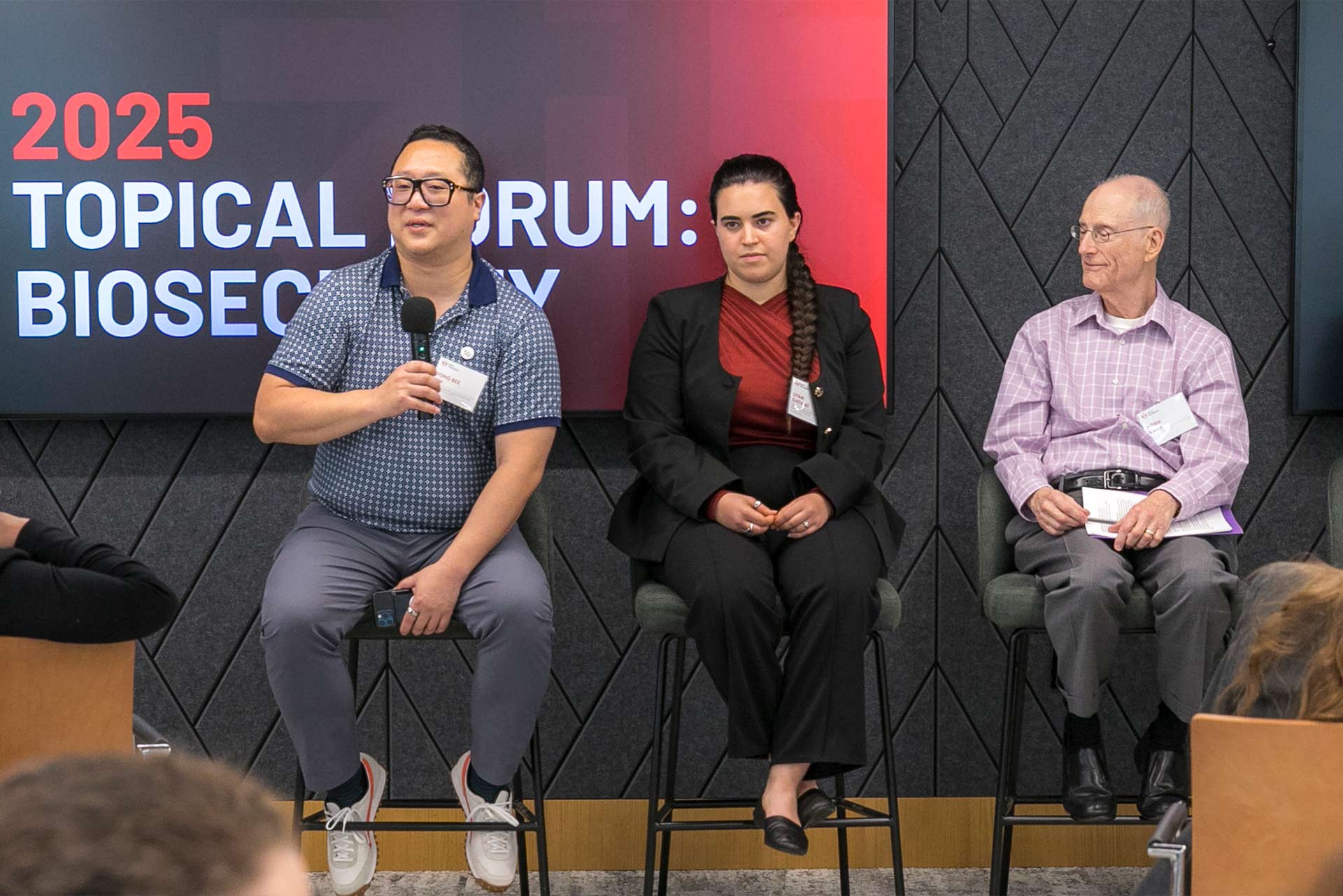
In September, Esvelt opened the 2025 Hertz Topical Forum: Biosecurity with this stark analogy. Then, over the course of one hard-hitting day, Hertz Fellows and biosecurity experts, from government officials and startup founders to international NGO leaders, grappled with an urgent question: As biology becomes as programmable as software, how do we prevent a catastrophe?
“Biosecurity matters now more than ever because there are so many changes both in the technological landscape within and outside of biology, and also in the geopolitical dynamics that we’re experiencing.”
Liyam Chitayat
What emerged was rigorous scientific dialogue that produced actionable insights. “Everyone I talked to said they learned a lot, and they want to keep learning and engaging,” said Hertz Fellow Gerald Epstein, a forum co-organizer. “We already know that the Hertz population is great at having technical skills, but the day really illustrated that there are also big societal problems that they can apply those skills to.”
The biosecurity landscape is shifting rapidly, speakers at the forum all emphasized. Advances in synthetic biology, gene editing, and AI are making biological systems easier to manipulate, while international cooperation frameworks weaken.
“Biosecurity matters now more than ever because there are so many changes both in the technological landscape within and outside of biology, and also in the geopolitical dynamics that we’re experiencing,” said Liyam Chitayat, a Hertz Fellow and MIT graduate student who co-organized the event.
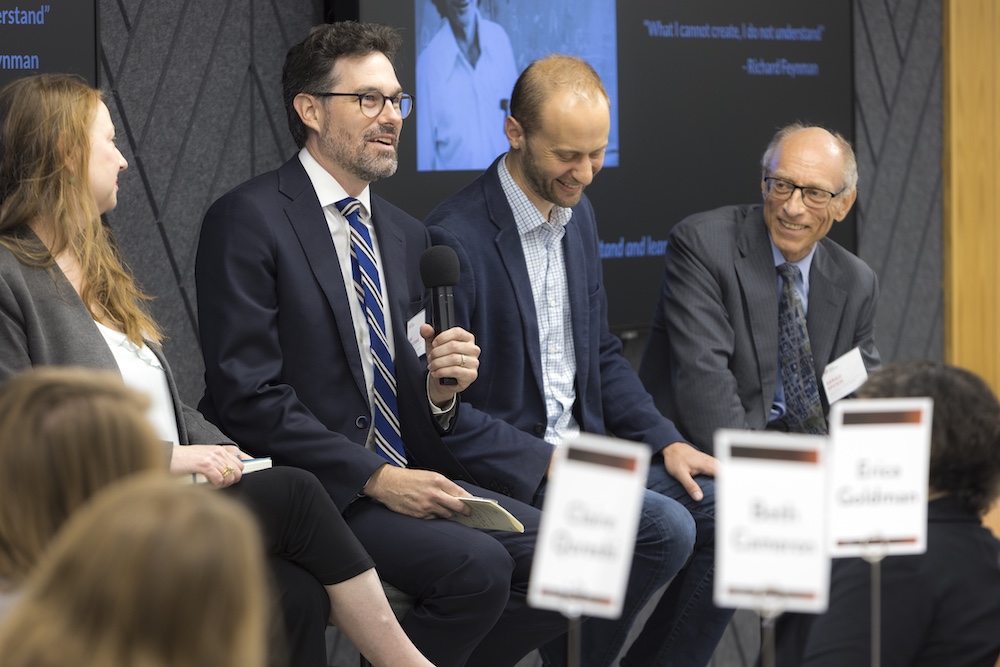
The Hertz Topical Forum: Biosecurity was made possible by the generosity of Eric and Wendy Schmidt and was co-hosted by the Federation of American Scientists (FAS). It was planned in just five weeks by Epstein, Chitayat, FAS contributors Erica Goldman and Yong-Bee Lim, and Hertz Foundation staff. Attendees included 24 Hertz Fellows spanning career stages, along with 29 experts, speakers, and staff who convened in Washington, D.C. Ten invited experts led table discussions on critical topics like biosecurity threats, opportunities, and career paths. They actively guided conversations, facilitated networking, and answered attendee questions.
A Perfect Storm of Converging Threats
Forum speakers highlighted different “modes of threat” for weaponization of biology: first, a “wildfire pandemic” spreading with extreme contagiousness and killing or debilitating over half of those infected, incapacitating so many critical infrastructure workers that societies fail to function. Another possibility is a “stealth pandemic,” infecting most humans before anyone knows it exists and lying dormant for a year or more before taking effect.
While these scenarios are hypothetical, they are not far-fetched. Research presented by Kevin Esvelt showed that 36 of 38 DNA synthesis companies in the United States shipped DNA sequences sufficient to recreate the 1918 flu, which killed 50 million, to a pseudonymous buyer without authorization. Meanwhile, AI is creating what DARPA’s Michael Koeris termed “an infinite threat space,” as AI enables the design of more potent pathogens, lowers the knowledge barrier for misuse, and automates the lab work required for development.
What can be done? Speakers proposed concrete defenses: screen all DNA synthesis with strict authorization, prevent AI from disclosing bioweapon designs, detect threats with untargeted metagenomic sequencing rather than only screening for known pathogens, and stockpile respiratory protection for 50 million critical workers. DARPA is working toward a goal to detect, diagnose, and defeat any biological agent within 48 hours.
Participants also explored governance gaps. The 1972 Biological Weapons Convention banned bioweapons development but lacks verification mechanisms. Effective biosecurity must survive political changes while remaining flexible — too many rigid rules create brittle systems, while too few leave dangerous gaps.
From Knowledge to Action
Understanding biosecurity threats and their potential solutions is only half the challenge. The other half is communicating that understanding to decision-makers who can act on it. The forum’s interactive workshop session with the FAS, led by Erica Goldman, Mike Stebbins, and Jonathan Wilson, taught participants how to translate complex scientific concepts into compelling policy messages.
“Administrations come and go; you must work effectively with whomever is in charge,” said Mike Stebbins, FAS Senior Advisor and former White House official.
The workshop encouraged participants to make their messages about biosecurity heard by writing meaningful, emotionally resonant calls to action using the Message Box framework developed by COMPASS. In the post-event survey, twelve participants expressed interest in drafting a policy memo (some of which have already been drafted and submitted), while more than half of all attendees committed to continuing the conversation around biosecurity in other ways such as fellowships, mentorships, or research collaborations. To facilitate ongoing engagement, the Hertz Foundation has created a participant directory and a WhatsApp chat where participants can keep in touch, and that to date has been an active site of discussion and resource-sharing.
“We already know that the Hertz population is great at having technical skills, but the day really illustrated that there are also big societal problems that they can apply those skills to.”
“It wasn’t just people presenting and people receiving. There was a lot of discussion, a lot of engagement,” said Epstein. For senior scientists who have been tackling biosecurity problems for decades, the forum renewed their energy. He added, “It makes those of us slogging away in the trenches feel better. We’ve got some help and there are younger folks on the way who are going to chip in.”
For graduate students and early-career scientists interested in the biosecurity space, the topical forum provided lessons on how to delve into the field — by being strategic about where you can have leverage and measuring your work’s impact. Fellowships and biosecurity resources were also discussed.
“I’m coming out of this workshop very optimistic!” said Chitayat. “It’s always so inspiring to see how thoughtful and how ambitious the people working in this field are. And in addition to that, there are so many opportunities right now to make a real measurable impact on a scale that’s really hard to imagine.”
The insights, connections, and commitment forged at the Hertz Topical Forum: Biosecurity represent not an endpoint, but the basis for sustained, high-impact collaboration.
To further advance this vital dialogue on the scientific community’s most urgent and relevant challenges, we invite committed individuals and organizations to connect with us.
Biosecurity Resources
Interested in learning more about biosecurity? Visit our Biosecurity Resources and Opportunities page to see fellowship opportunities, readings and resources discussed during the Topical Forum.
LEARN MOREAbout the Hertz Foundation
The Hertz Foundation is the nation’s preeminent nonprofit organization committed to advancing American scientific and technological leadership. For more than 60 years, it has stood as an unwavering pillar of independent support through the renowned Hertz Fellowship, cultivating a multidisciplinary network of innovators whose work has positively impacted millions of lives. Learn more at hertzfoundation.org.