

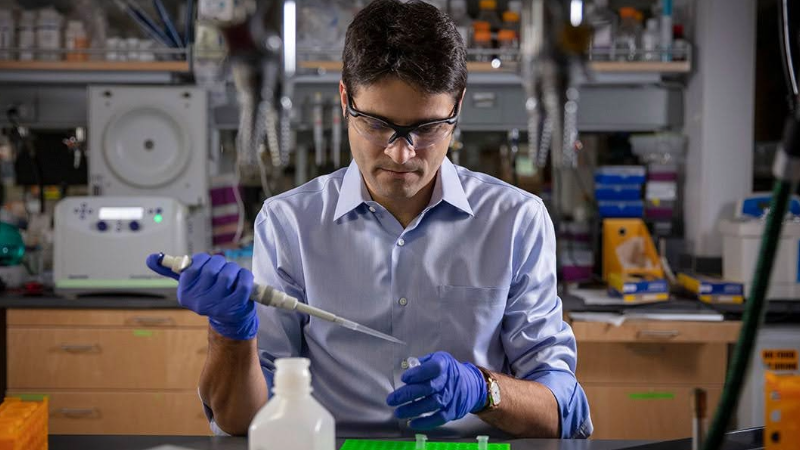
Hertz Fellow Mikhail Shapiro remembers the moment he realized tiny proteins in microbes could revolutionize brain science.
During a postdoctoral fellowship at University of California, Berkeley, he learned of an interesting phenomenon for maintaining buoyancy—gas vesicles discovered inside blue-green algae floating in lakes around the turn of the 20th century.
Shapiro ordered blue-green algae, but not having a growth chamber to cultivate in, he simply placed the algae inside a flask under a fluorescent light above his workbench. To his surprise, the algae grew, and he extracted the air-filled proteins from its cells. Using an abandoned piece of ultrasound equipment in the lab’s basement, he discovered that the gas vesicles produced a signal and were detectable with ultrasound, confirming his hypothesis.
Nearly two decades later, that curiosity has led to Merge Labs, a brain-computer interface company that emerged from stealth in January 2026 with $250+ million in seed funding from OpenAI and other major investors. The venture, co-founded with OpenAI CEO Sam Altman, aims to let people control computers with their thoughts — without surgery.
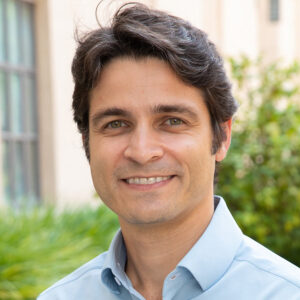
“One of our core beliefs is that we can build brain computer interfaces that can interface with many more neurons in the brain than is possible with existing technologies in a form factor that is much less invasive,”
The approach differs from other companies that implant electrodes through surgery. Shapiro’s team combines ultrasound imaging with biomolecules that respond to sound waves. The technology could be used to treat paralysis, depression and other neurological disorders.
Freedom to pursue risky ideas
In 2004, the Hertz Foundation awarded Shapiro the Hertz Fellowship, which provides graduate students up to $250,000 over five years with no strings attached. The unrestricted funding allowed him to pursue high-risk research without satisfying grant committees — freedom that enabled his gas vesicle discoveries.
He credits the program for connecting him with a network of ambitious scientists across disciplines. During Hertz retreats, conversations with fellows from physics, neuroscience and computer science sparked ideas that shaped his career. In 2013, Shapiro co-authored a paper with Hertz Fellows Adam Marblestone, Ed Boyden and Dario Amodei that explored theoretical approaches to large-scale brain recording.
Shapiro won the Hertz Foundation’s thesis prize in 2009 for developing the first genetically engineered contrast agents for MRI. Since joining Caltech in 2014 as a chemical engineering professor, he has earned national recognition including a 2021 NIH Pioneer Award and designation as a Howard Hughes Medical Institute investigator.
Multiple former Shapiro lab members have joined Merge Labs, which plans to first develop medical applications before pursuing consumer products. The brain-computer interface field is advancing rapidly, with research teams worldwide racing to crack fundamental challenges.
The Hertz Foundation’s emphasis on taking bold risks in service of larger goals continues to shape Shapiro’s work. As the foundation marks more than 60 years of supporting exceptional scientists, his venture exemplifies how early-career freedom can lead to breakthroughs decades later — making history in ways the fellowship’s founders might never have imagined.
About the Hertz Foundation
The Hertz Foundation is the nation’s preeminent nonprofit organization committed to advancing American scientific and technological leadership. For more than 60 years, it has stood as an unwavering pillar of independent support through the renowned Hertz Fellowship, cultivating a multidisciplinary network of innovators whose work has positively impacted millions of lives. Learn more at hertzfoundation.org.

