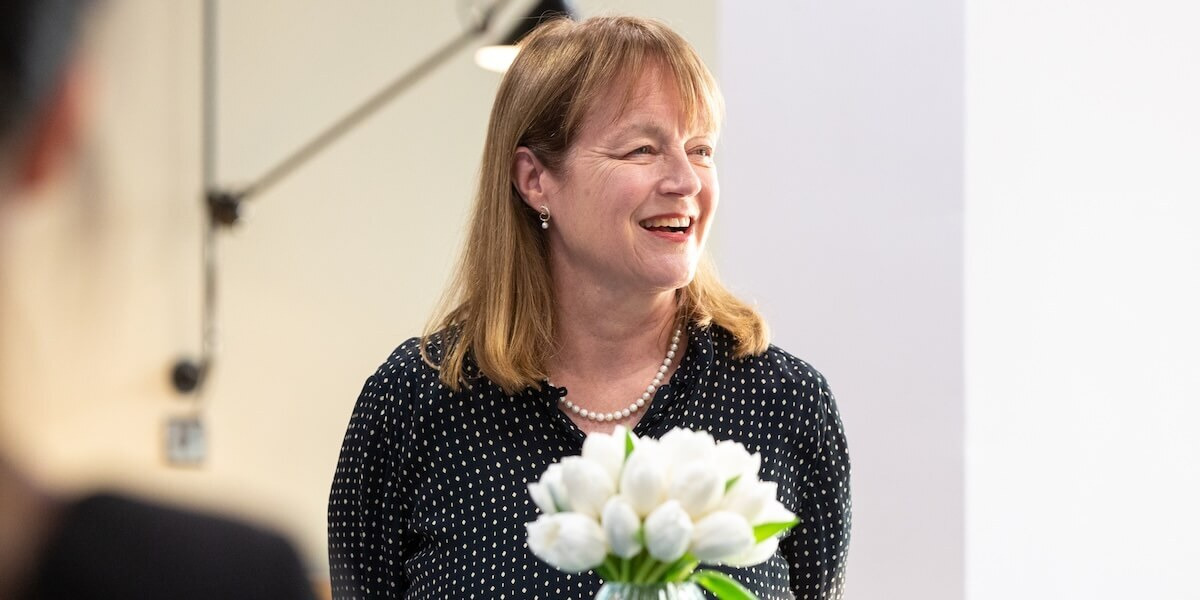
A note from Hertz Foundation President Wendy Connors: As we were preparing to publish this story, we were sad to hear the news that Alice Gast passed away on October 27, 2025, at age 67, after a battle with pancreatic cancer. Just prior, we were sitting with Alice, grateful for the chance to learn more about her extraordinary career and life. We’re honored to be able to share that with you here.
Reflecting on her career, Hertz Fellow Alice Gast has much to be proud of.
For her research in chemical engineering, she received numerous awards and honors, including the Humboldt Research Award, the National Academy of Sciences Award for Initiatives in Research, and the Colburn Award, one of the most prestigious honors of the American Institute of Chemical Engineers (AIChE).
She held teaching and leadership roles at prestigious universities, including Stanford, Massachusetts Institute of Technology (MIT), Lehigh University, and Imperial College London. At both Lehigh and Imperial, she was the first female president.
And she held positions of influence in private industry and government, including her appointment as a U.S. Science Envoy to Central Asia in 2010, exploring potential areas of collaboration on globally relevant issues and deepening her belief in the value of international science diplomacy.
But today, she’s especially proud of her Pears Cumbria School of Medicine sweatshirt.
The shirt is a recent gift from former colleagues who just opened the new medical school near her home in rural England. The Pears Cumbria School of Medicine (PCSM) was established through a first-of-its-kind collaboration between the University of Cumbria and Imperial College London, where Gast served as president until July 2022 and where she is currently professor emeritus in chemical engineering. The school was established to train and retain more medical professionals in the underserved communities of Cumbria and Northwest England.
Gast shrugs off any credit, insisting it was not her project. That said, the PCSM was conceived under her leadership. And this success, like any in science, did not happen overnight.
The power of interdisciplinary collaboration
Alice Gast was born in Houston, Texas, and began her career as a chemical engineering intern at Chevron in 1978. She graduated as valedictorian from the University of Southern California in 1980, earned her master’s and doctorate degrees in chemical engineering from Princeton in 1984, and began a NATO postdoctoral fellowship in Paris in 1985.
But it was her work as a chemical engineering professor at Stanford that she calls “the height of my research career.” Gast gained wide recognition for her contributions to colloid and surface phenomena, on which she authored many scientific publications and a classic textbook. And she strengthened her belief in the importance of interdisciplinary, not just multi-disciplinary, collaboration.
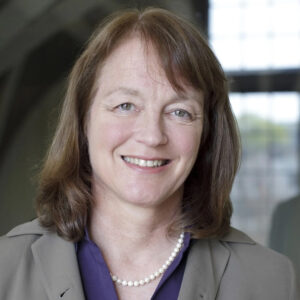
“You can’t unmix it. When we connect people and ideas, we advance our shared understanding in a way that can’t be undone.”
Alice Gast
“Multi-disciplinary means many, together, which we know is critical in research and innovation,” she says. “But I am even more interested in inter-disciplinary collaboration, which means between.”
Gast brought this thinking to each of her leadership roles. As vice president for research and associate provost at MIT, she facilitated a collaboration between MIT and Harvard to found the independent Broad Institute in 2004. At Lehigh, she worked to integrate education with research and to more closely connect the graduate and undergraduate programs. At Imperial College London, she responded to post-Brexit isolationism by initiating major new partnerships with institutions in Europe, empowering new routes to collaboration. And now, an American living in England, she continues to reach across borders as a member of boards and councils in the U.S., Finland, Germany, and Singapore.
Gast is committed to bridging labs, universities, institutions—even nations.
The importance of long-term investment
Asked how it felt to sometimes be the only woman in the room, Gast has to pause and think for a moment. “I was keenly aware that I was one of three women in a graduating class of 30,” she says of her educational experience. But to her, diversity is much bigger than just her own story.
At Imperial, for example, Gast recognized that too few women were benefiting from the university’s start-up culture, so she helped create a program to provide women entrepreneurs access to funding and mentoring at the earliest stage.
Gast knows that diversity is critical to scientific advancement and innovation. She’s particularly interested in cultural diversity and how it can inform and expand research and ideas—something she experienced working with colleagues from Mexico, Germany, and France.
In her piece, “Why science is better when it’s multinational” (Scientific American, May 2012), she describes how cultural differences can force teams to work and think in new ways. For example, her French colleagues showed her the value of investigating a problem with not just equations but also intuition. And her Mexican colleagues dared her team to break unbreakable rules, if only temporarily, to help overcome mental roadblocks.
Gast notes that these collaborations often produced unease and sometimes even conflict. But ultimately, she concedes, the work was better. The long-term benefits outweighed the short-term discomfort—even if it took a few years.
Gast knows firsthand the value of investments made long ago. Diagnosed with pancreatic cancer in 2021, Gast is grateful for the decades-long investments that have yielded better diagnostic tools like the MRI, as well as more highly targeted drugs. At the same time, she knows more research is needed, which requires sustained investment.
“Scientific progress depends on stable, long-term funding for research,” she says. “This is where foundations like the Hertz Foundation play such a crucial role. They help advance science even when government funding might be unpredictable.”
Despite tensions between or within countries, Gast is confident that science will continue to transcend boundaries, unite people, and invite collaboration more than competition. “You can’t unmix it,” she says, nodding to the Second Law of Thermodynamics. “When we connect people and ideas, we advance our shared understanding in a way that can’t be undone—no matter how many borders or barriers are put up. Science is a unifying force.”
And so is Alice Gast.
About the Hertz Foundation
The Hertz Foundation is the nation’s preeminent nonprofit organization committed to advancing American scientific and technological leadership. For more than 60 years, it has stood as an unwavering pillar of independent support through the renowned Hertz Fellowship, cultivating a multidisciplinary network of innovators whose work has positively impacted millions of lives. Learn more at hertzfoundation.org.